
T700 Carbon Fiber Pickleball Paddles Explained (T700 vs T300)
You’ll see ‘T700’ on hundreds of paddle listings. Here’s what it actually means, how it compares to T300, and whether it should influence what you buy.
Quick answer
T700 is a grade of carbon fiber, originally a product name from the Japanese manufacturer Toray, with higher tensile strength than T300. In a pickleball paddle, a T700 face generally means a stronger, more durable carbon surface that can be made with a raw, gritty texture for spin. It is a good sign, but not a guarantee of a great paddle: the core, construction, shape and brand quality matter just as much.
What is carbon fiber?
Carbon fiber is made from extremely thin strands of carbon atoms, each far thinner than a human hair. Thousands of these strands are bundled into “tows”, woven into sheets and bonded with resin. The result is a material that is very strong and stiff for its weight, which is why it is used in aircraft, race cars, bicycles, golf shafts and, increasingly, pickleball paddles.
In paddles, carbon fiber is used mainly for the face. Its stiffness spreads the impact of the ball across the face, giving a precise, controlled feel. When the surface is left raw or textured, it also grips the ball for heavy spin. Learn more in carbon fiber vs fiberglass.
What do T300 and T700 mean?
Carbon fiber is graded by its mechanical properties, mainly tensile strength (how much pulling force it can withstand before breaking) and tensile modulus (how stiff it is). “T300” and “T700” are grade names that started with Toray and are now widely used as shorthand across the industry, including by other manufacturers making equivalent fibers.
- T300 is a long-established, standard-modulus carbon fiber used widely in sporting goods.
- T700 has significantly higher tensile strength than T300 while keeping a similar standard modulus. It is tougher and more resistant to impact damage.
- Higher grades such as T800 and T1000 exist with even greater strength, but they are much more expensive and rarely used in paddle faces.
T700 vs T300 carbon fiber paddles
| T300 | T700 | |
|---|---|---|
| Tensile strength | Standard | Higher |
| Stiffness | Standard modulus | Standard modulus |
| Impact resistance | Good | Better |
| Texture durability | Good | Better |
| Common in | Budget carbon paddles | Mid-range and premium paddles |
| Cost | Lower | Higher |
What T700 means for your game
Durability
The most direct benefit of T700 is toughness. A T700 face is more resistant to impact damage and tends to hold its surface texture longer, which means spin lasts longer before wearing down.
Spin
T700 itself does not create spin; texture does. But because T700 is strong and durable, manufacturers commonly use it for raw or textured faces, which do generate heavy spin. In practice, “raw T700 carbon” on a listing usually means a spin-friendly face.
Feel
Carbon grade has a subtle effect on feel compared with the core, thickness and construction. Two T700 paddles with different cores can feel completely different. Do not choose a paddle on carbon grade alone.
Why “T700” is everywhere on paddle listings
As raw carbon became popular, “T700” became a marketing label. Today, hundreds of paddles at every price advertise T700 faces, including many inexpensive models. That is not necessarily a problem, but it means T700 no longer separates premium paddles from budget ones on its own. A cheap T700 paddle with a basic glued core and loose quality control will not play like a premium paddle.
Big brands often skip grade names entirely and use their own branded carbon faces. Selkirk uses Florek carbon fiber on paddles like the LUXX Control and the Tesla Plaid collaboration, and JOOLA describes the Pro V’s face as raw textured carbon. These are premium carbon faces even if the listing does not say “T700”.
How carbon fiber faces are made
Understanding manufacturing helps explain why two “T700” paddles can feel different. Carbon fiber is usually supplied as “prepreg”: carbon sheets already impregnated with resin. Manufacturers cut these sheets, layer them in specific orientations and cure them under heat and pressure. The number of layers, the weave pattern, the resin system and the curing process all affect stiffness, durability and texture.
To create a raw or textured surface, manufacturers may leave the weave exposed, press a texture into the surface during curing or add a grit layer. Each method produces a slightly different feel and spin profile, and each must stay within USA Pickleball’s limits for surface roughness.
That is why grade alone does not tell the whole story. Two paddles can use the same T700 fiber but differ in layup, resin, texture method and quality control, producing noticeably different results on court.
Weave patterns: 3K, 12K and unidirectional
You may also see terms like 3K, 12K or UD on paddle listings. These describe how the carbon is woven:
- 3K: each tow contains about 3,000 filaments, producing a fine, classic checkerboard weave.
- 12K: larger tows of about 12,000 filaments, producing a bolder weave pattern.
- UD (unidirectional): fibers run in a single direction rather than being woven, often used for specific stiffness properties.
Weave pattern affects appearance and can subtly influence stiffness and texture, but like carbon grade, it is a smaller factor than the core and construction.
T700 and arm comfort
Because carbon is stiff, some players worry that carbon faces transmit more vibration. In practice, the core and paddle thickness have a far bigger effect on comfort. A T700 face on a 16mm or foam core can feel very soft and comfortable, while the same face on a thin core feels crisper. Players with arm sensitivity should focus on core choice first.
How to judge a T700 paddle
Use T700 as one data point in a bigger picture. When comparing paddles, check:
- Surface: is it described as raw or textured? That drives spin.
- Core: what type and thickness? Honeycomb thickness or a foam core changes the feel dramatically. See foam core vs honeycomb.
- Construction: is it thermoformed or unibody? That adds power and stability. See thermoformed paddles.
- Shape and weight: elongated or wide-body? Light or heavy?
- Brand and reviews: we recommend 4.2 stars or higher from established brands.
- USA Pickleball approval: essential for sanctioned play.
If a paddle has a raw T700 face, a well-specified core, solid construction, strong reviews and approval, it is likely a good buy at its price.
T700 paddles worth considering
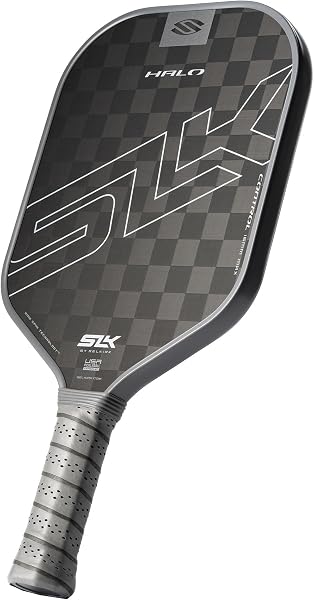
Selkirk SLK Halo
★ 4.7 · 141 Amazon reviewsT700 raw carbon face from Selkirk.

Selkirk SLK Geo
★ 4.3 · 81 Amazon reviewsT700 carbon fiber face in a value paddle.
Premium carbon paddles (branded carbon faces)

JOOLA Pro V (Perseus)
★ 4.4 · 162 Amazon reviewsRaw textured carbon with KineticFrame.

Selkirk LUXX Control
★ 4.4 · 598 Amazon reviewsSelkirk luxury control paddle.

Selkirk SLK ERA Power
★ 4.5 · 283 Amazon reviewsLively Selkirk power paddle.

Six Zero Double Black Diamond Control
★ 4.6 · 26 Amazon reviewsBoutique raw carbon paddle.
Is T700 better than other materials?
Compared with fiberglass, yes, for control, spin and durability. Compared with T300 carbon, yes, for strength and durability. Compared with premium branded carbon faces, it depends on the specific paddle. Compared with hybrid faces that include Kevlar, it is stiffer and more precise, while Kevlar hybrids add dampening and pop.
Does carbon grade affect price?
Yes, but less than you might think. Higher-grade carbon costs more, but the biggest price differences between paddles come from core technology, construction methods, R&D and brand. A $100 T700 paddle and a $300 flagship can both use excellent carbon; the flagship’s extra cost comes mostly from everything else. Read Why Are Pickleball Paddles So Expensive?
T700 on budget vs premium paddles
On a budget paddle, a T700 face is a genuine upgrade over fiberglass or smooth graphite, and it can make an inexpensive paddle surprisingly spin-friendly. The compromises usually come elsewhere: simpler cores, glued rather than thermoformed construction, looser quality control and shorter warranties.
On a premium paddle, the carbon face is just one of many refined components. The core is carefully tuned, the construction is more advanced and every paddle is held to tighter standards. That is why a premium paddle with a similar carbon grade can play more consistently and last longer.
Common myths about T700
- “T700 paddles are all premium.” Many budget paddles now use T700; check the rest of the specs.
- “T700 creates spin.” Texture creates spin; T700 helps the texture last.
- “Higher grade always means better play.” Feel depends much more on the core and construction.
- “Branded carbon is just marketing.” Named faces like Florek carbon are premium carbon; brands simply describe them differently.
Caring for a T700 face
Even durable T700 faces wear with use. Clean the face gently with a damp microfiber cloth or paddle eraser, avoid harsh chemicals and store the paddle in a cover. Keep it out of hot cars. See How Long Does a Pickleball Paddle Last?
T700 vs T800 and beyond
Higher grades like T800 and T1000 offer even more strength and are used in aerospace and high-end sporting goods. In pickleball paddles, the benefit over T700 is small compared with the extra cost, and USA Pickleball’s surface rules limit how aggressive a face can be. For now, T700 and branded premium carbon faces represent the practical sweet spot.
Choosing a T700 paddle by player level
| Level | What to look for | Example |
|---|---|---|
| Beginner | Any well-reviewed carbon paddle with a forgiving shape | Selkirk SLK Geo |
| 3.0–3.5 | Raw T700 face with a 16mm core | Selkirk SLK Halo |
| 3.5–4.5 | Premium carbon face matched to your style | Selkirk LUXX Control or JOOLA Pro V |
| 4.5+ | Premium carbon with the exact core and shape you need | JOOLA Pro V, CRBN Genesis or Paddletek TKO-CX |
Questions to ask before buying
- Does the listing specify the core type and thickness, not just the carbon grade?
- Is the face described as raw or textured?
- How many reviews does the paddle have, and what is the average rating?
- Is it USA Pickleball approved?
- Does the brand offer a real warranty?
If the answer to most of these is yes, a T700 paddle can be an excellent buy at almost any price.
In short, treat T700 as a helpful sign of quality rather than the deciding factor, and let your play style guide the final choice.
When you find a paddle you like, read a handful of detailed buyer reviews to confirm how it plays in real games.
Those reviews often reveal more about feel and durability than any spec sheet can.
Key takeaways
- T700 is a stronger carbon grade than T300, improving durability.
- Texture, not grade, creates spin; T700 helps texture last.
- Core and construction affect feel more than carbon grade.
- Many budget paddles now advertise T700, so check the full specs.
The bottom line
T700 is a strong, durable carbon grade and a good sign on a paddle listing, especially when paired with a raw or textured surface. But it is only one part of what makes a great paddle. Look at the core, construction, brand and reviews too. For paddles that get every part right, see our ranking of the 10 most expensive pickleball paddles.
T700 in the most expensive paddles
Flagship paddles rarely advertise a carbon grade at all. Instead, brands describe their faces as raw textured carbon, Florek carbon or other proprietary names, and focus marketing on cores and construction. That is a useful reminder that grade alone does not define a premium paddle. A well-built mid-range paddle with a T700 face can be an excellent buy, while the most expensive paddles earn their price through the combination of face, core, construction and testing.
Frequently Asked Questions
Is T700 carbon fiber good for pickleball paddles?
Yes. It is a strong, durable carbon grade, but the core and construction matter just as much.
What is the difference between T700 and T300?
T700 has higher tensile strength than T300, making it tougher and more durable.
Does T700 carbon give more spin?
Spin comes from texture; T700 is commonly used for raw textured faces and helps the texture last.
Do premium paddles use T700?
Many do, though big brands often use named carbon faces like Selkirk Florek carbon.
What does T700 stand for?
It is a carbon fiber grade name that originated with Toray and is now used widely across the industry.