10 Most Expensive Pickleball Paddles (2027) Worth the Money
We researched the priciest paddles on Amazon, read through 2,000+ verified buyer reviews and kept only the ones rated 4.2★ or higher. Here’s what’s actually worth buying.
The short answer
The most expensive pickleball paddle you can buy on Amazon is the JOOLA Pro V (around $300). Out of the 10 premium paddles we compared, these are the three we’d buy:

JOOLA Pro V (Perseus)
★ 4.4 · 162 Amazon reviews3.5+ players who want the best, most complete paddle JOOLA makes.

CRBN TruFoam Genesis
★ 4.5 · 135 Amazon reviewsControl players and anyone tired of paddles going ‘dead’.

Selkirk SLK ERA Power
★ 4.5 · 283 Amazon reviewsIntermediate players stepping up to premium.
The 10 Most Expensive Pickleball Paddles on Amazon
Ranked from most to least expensive. Tap a paddle’s review link for the full breakdown, or check today’s price on Amazon.



Price tiers are approximate. Amazon prices change often, so always check the live price.
How We Researched the Most Expensive Pickleball Paddles
We did not simply sort Amazon by price. A high price on its own tells you nothing about whether a paddle plays well, and some of the most expensive listings on Amazon are resellers adding a mark-up to older models. Instead, we used four filters:
- Premium price tier. We focused on paddles in roughly the $150–$300 range – the top of the market for paddles you can actually play with.
- Buyer ratings of 4.2★ or higher. Expensive paddles that real buyers were not happy with did not make the cut.
- Enough reviews to trust. In total, the paddles on this list carry more than 2,000 Amazon buyer reviews.
- Trusted brands and real technology. Every paddle comes from an established brand and offers something meaningful – a new frame design, a foam core, a premium carbon face – rather than just a premium price.
We then compared each paddle’s construction, shape, materials and buyer feedback to explain who it suits best. Prices on Amazon change often, so we show price tiers rather than exact prices. Always click through to check the current price.
The Most Expensive Pickleball Paddles in the World
Before we get to paddles you can buy on Amazon, let’s look at the record holders. None of these are practical choices for winning games, but they explain why “most expensive pickleball paddle” is such a popular search.
JOOLA Ben Johns Gold Perseus – around $8,000
The Gold Perseus was a limited run of only 100 paddles made to celebrate Ben Johns, the most decorated player in pickleball history. Because so few exist, collectors have paid around $8,000 for one on the resale market. It is a playable paddle, but almost nobody who owns one takes it to the court – it is a trophy.
Louis Vuitton pickleball set – around $100,000
Louis Vuitton made headlines with a luxury pickleball set reported at around $100,000. It is a fashion statement rather than sports equipment, and it is the main reason pickleball now appears in luxury-lifestyle news.
Versace pickleball set – around $9,000
Versace has also entered the sport with a designer pickleball set at roughly $9,000. Like the Louis Vuitton set, it is about brand and design rather than performance.
The takeaway: the most expensive paddles in the world are collector and designer items. For performance, the real “most expensive” paddles are the premium carbon paddles below – and they cost a fraction of the price.
JOOLA Pro V (Perseus)
★ 4.4 · 162 Amazon reviews- Shape
- Elongated (16.5″ × 7.5″)
- Weight
- ~8.1 oz average
- Grip length
- 5.5″
- Thickness
- 14mm or 16mm
- Face
- Raw textured carbon fiber
- Tech
- KineticFrame construction
- Play style
- Power & all-court
- Price tier
- $$$$$ (~$300)
If you want the single most expensive mainstream pickleball paddle you can order on Amazon today, this is it. The JOOLA Pro V is the fifth generation of the Perseus line – the paddle family that Ben Johns, Collin Johns and a long list of tour pros have used to win titles. Every generation has pushed the price ceiling a little higher, and the Pro V sits right at the top of the market at around the $300 mark.
So what are you paying for? The headline feature is JOOLA’s new KineticFrame construction. JOOLA describes it as working like a hockey stick: the frame flexes slightly as you swing, stores energy, and releases it through the ball. In practice that means drives and put-aways come off the face with real pop, but the paddle does not feel like a stiff, uncontrollable trampoline when you are blocking or dinking. That balance between power and touch is exactly what earlier power paddles struggled with.
The face is raw, textured carbon fiber, which is what gives modern premium paddles their bite on the ball. Topspin rolls, cut serves and slice returns all grab noticeably more than on a fiberglass or smooth graphite paddle. The elongated Perseus shape – 16.5 inches long and 7.5 inches wide – gives you extra reach at the kitchen line and a faster-feeling swing, while the 5.5-inch handle leaves room for two-handed backhands.
Buyers on Amazon rate it 4.4 out of 5 across more than 160 reviews, with the most common praise centred on spin, pop and the feeling of a ‘complete’ paddle. The main critical comments are about price, and the fact that an elongated paddle has a slightly narrower sweet spot than a wide-body shape. Both are fair, and both are true of almost every flagship paddle on this list.
Who should buy it? Intermediate-to-advanced players (roughly 3.5 and up) who play several times a week and want one paddle that can do everything. If you are moving up from a $100–$150 paddle, the jump in spin and power is very easy to notice. If you are a true beginner, you will get more value from one of the lower-tier options further down this list.
What we like
- KineticFrame adds easy power without losing touch
- Raw carbon face produces heavy spin
- Long Perseus shape for reach and two-handed backhands
- Choice of 14mm (more pop) or 16mm (more control)
- Tour-proven paddle family
Keep in mind
- The most expensive paddle on this list
- Elongated shape is less forgiving on off-centre hits than a wide body
JOOLA 3S
★ 4.4 · 182 Amazon reviews- Shape
- Elongated, wide body
- Face
- Raw carbon fiber
- Design
- Aero Curve frame
- Best for
- Fast hands / kitchen battles
- Feel
- Crisp, lively
- Reviews
- 182+ on Amazon
- Play style
- Power + spin
- Price tier
- $$$$ (~$240)
The JOOLA 3S is the paddle for players who live at the kitchen line and win points with fast hands. Where the Pro V is the all-rounder, the 3S is built around speed: its Aero Curve frame is shaped to cut through the air, so the paddle feels quick in hand during rapid-fire volley exchanges.
What makes the 3S interesting is that JOOLA combined an elongated profile with a wider body than you usually see on long paddles. That gives you some of the reach and leverage of an elongated shape while keeping a more generous sweet spot. Mishits towards the edge still come back over the net with surprising stability, which builds confidence when the ball is coming at you hard.
The raw carbon fiber surface delivers the gritty texture you expect at this price, and it produces a lot of spin on rolls and serves. Power is lively without being wild – think crisp and responsive rather than mushy. Players who like to counter-attack and speed up off the bounce tend to love this kind of response.
With 4.4 stars across 182+ reviews, the 3S has one of the stronger review profiles on this list. Owners consistently mention its speed and spin. The most common caution is that it takes a few sessions to calibrate the extra pop on soft shots, which is normal for any lively carbon paddle.
At roughly $240 it sits just below the Pro V, and for a lot of aggressive doubles players it is honestly the more fun paddle to use. If your game is about hands battles, speed-ups and quick resets, the 3S deserves a serious look.
What we like
- Aero Curve frame feels very fast in hand
- Elongated reach with a wide-body sweet spot
- Strong spin from the raw carbon face
- Excellent review count and rating
Keep in mind
- Lively face needs a few sessions to control on dinks
- Still a premium price over JOOLA’s Hyperion line
CRBN TruFoam Genesis
★ 4.5 · 135 Amazon reviews- Core
- 100% foam (no honeycomb)
- Face
- Carbon fiber
- Development
- 18 months, 200+ prototypes
- Break-in
- None needed
- Feel
- Soft, consistent
- Reviews
- 135+ on Amazon
- Play style
- Control + consistency
- Price tier
- $$$$ (~$230)
The CRBN TruFoam Genesis is one of the most talked-about paddles of the last year, and for good reason. Instead of the polypropylene honeycomb core used in most paddles, CRBN built the Genesis around a 100% foam core. According to CRBN, it took 18 months of development and more than 200 prototypes to get it right.
Why does that matter? The two biggest complaints about expensive honeycomb paddles are ‘core crush’ and inconsistency. Over months of hard hitting, the honeycomb cells can break down. The paddle starts to feel dead in spots, or hotter in others, and you are suddenly shopping for a replacement. A full-foam core is designed to avoid that problem completely. It also means there is no break-in period: the Genesis plays the same on day one as it does on day three hundred.
On court, the feel is soft, plush and very predictable. Dinks and drops land where you aim them, and resets from the transition zone feel calmer than with a crisp honeycomb paddle. Power is there when you swing for it, but this is fundamentally a control-first paddle. The carbon fiber face still gives you plenty of spin to work with.
It also holds the highest buyer rating on our list – 4.5 stars across 135+ reviews. Owners love the consistency and the quiet, solid sound off the face. The main thing to know is that foam feels different from honeycomb. If you have played honeycomb paddles for years, give yourself a few games to adjust.
For players who are tired of spending $200+ on a paddle only for it to die in six months, the Genesis is arguably the smartest premium purchase you can make. Paying a little more up front for something that stays consistent longer is real value.
What we like
- All-foam core designed to eliminate core crush
- No break-in – consistent from day one
- Outstanding touch for dinks, drops and resets
- Highest buyer rating on this list (4.5★)
Keep in mind
- Foam feel takes a few games to get used to
- Not the most explosive paddle for pure bangers
CRBN TruFoam Barrage
★ 4.4 · 74 Amazon reviews- Core
- Floating 100% foam
- Face
- Carbon fiber
- Level
- Advanced players
- Feel
- Powerful, stable
- Sibling model
- TruFoam Genesis
- Reviews
- 74+ on Amazon
- Play style
- Power
- Price tier
- $$$$ (~$230)
The Barrage takes the same TruFoam idea as the Genesis and tunes it for power. CRBN calls it an elite carbon fiber paddle for advanced players, and it uses what the brand describes as a floating foam core – a construction designed to add pop while keeping the durability benefits of foam.
Think of the Genesis and the Barrage as two sides of the same coin. The Genesis is the touch paddle; the Barrage is the one you pick up when you want to finish points. Drives come off the face with more pace, overheads have more authority, and counter-attacks at the net have extra bite. Because it is still a foam paddle, it avoids the hollow, inconsistent feel that power-focused honeycomb paddles can develop over time.
The carbon fiber surface gives you strong spin, which pairs well with the added power – topspin drives dip into the court instead of flying long. Stability is good on off-centre hits, so blocks against hard drives feel solid.
With 74+ reviews and a 4.4-star rating, the Barrage has a smaller review history than the Genesis because it is a newer model, but early buyers are positive. The main caution is simple: this is a lot of paddle for a beginner. Newer players may find it harder to control the soft game.
If you already play an aggressive style, like the idea of foam durability, and the Genesis sounds too soft for you, the Barrage is the natural pick.
What we like
- Foam durability with a more powerful response
- Strong spin to keep hard drives in
- Stable on blocks and counters
- Same price tier as the Genesis
Keep in mind
- Smaller review history (newer model)
- Too much power for most beginners
Selkirk LUXX Control
★ 4.4 · 598 Amazon reviews- Brand
- Selkirk Sport (USA)
- Face
- Florek carbon fiber
- Focus
- Control and touch
- Model year
- 2024
- Feel
- Soft, precise
- Reviews
- 598+ on Amazon
- Play style
- Control & touch
- Price tier
- $$$$ (~$230)
Selkirk is one of the most respected names in pickleball, and the LUXX line is its luxury tier. The LUXX Control is exactly what the name says: a premium paddle designed for players who win with precision rather than brute force.
Its standout feature is the Florek carbon fiber face. It gives a soft, connected feel at contact, so you can sense where the ball is on the face. That feedback is a big deal when you are trying to place third-shot drops into the kitchen or hold your own in a long dinking rally. The paddle gives you time to shape the ball rather than having it ping off the face.
Where this paddle really stands out is its track record. With nearly 600 reviews and a 4.4-star average, it is the most battle-tested paddle on our list by a wide margin. That matters at this price: you are not buying a brand-new, unproven design, you are buying something hundreds of players have already lived with.
The trade-off is power. The LUXX Control is not built to blast drives past people, and big hitters will find it a little muted compared to the Pro V or the Barrage. It is also a 2024 model, so it does not have the very latest frame tech – although that has also pulled its price down from where it launched.
If your game is built on dinks, drops and patience, and you value Selkirk build quality and customer support, the LUXX Control remains one of the safest premium buys on Amazon.
What we like
- 598+ reviews – the most proven paddle here
- Florek carbon gives a soft, connected feel
- Excellent for dinks, drops and resets
- Selkirk quality and support
Keep in mind
- Less raw power than newer paddles
- 2024 model, not the newest tech
Franklin C45 Carbon Fiber
★ 4.4 · 189 Amazon reviews- Brand
- Franklin Sports
- Face
- Carbon fiber
- Approval
- USA Pickleball (USAP) approved
- Use
- Tournament play
- Feel
- Balanced
- Reviews
- 189+ on Amazon
- Play style
- Balanced
- Price tier
- $$$$ (~$230)
Franklin is best known in pickleball for its balls – the X-40 is used at the US Open – but the C45 shows it also makes serious premium paddles. It is Franklin’s carbon fiber tournament paddle, and it is USA Pickleball approved, so you can take it to sanctioned events without worrying.
The C45’s big strength is balance. It does not lean hard towards power or towards control; it sits right in the middle. That makes it a comfortable paddle for players who are still working out their style, or for players who simply want a dependable tool that does everything reasonably well. Drives have decent pace, dinks are manageable, and the paddle feels stable in quick exchanges.
The carbon fiber face provides a solid level of grip and spin, though it is not as aggressive as the raw textured faces on the JOOLA paddles. If heavy topspin is a priority, keep that in mind. On the other hand, the C45 is very predictable, which many tournament players prefer under pressure.
With a 4.4-star rating across 189+ reviews, it has a strong reputation on Amazon, and Franklin’s huge retail presence means support and replacements are easy to find. Design-wise, it is understated compared with the flashier JOOLA and Selkirk models.
If you want a trusted brand, a USAP-approved paddle and a balanced feel for competitive play, the C45 is an easy recommendation.
What we like
- USAP approved for sanctioned tournaments
- Balanced mix of power and control
- Predictable, stable feel under pressure
- Trusted brand with wide availability
Keep in mind
- Less spin than raw-carbon paddles
- Plainer design than JOOLA or Selkirk
Selkirk SLK ERA Power
★ 4.5 · 283 Amazon reviews- Brand
- Selkirk (SLK line)
- Face
- Carbon fiber hybrid
- Focus
- Power
- Price tier
- ~$200
- Feel
- Lively
- Reviews
- 283+ on Amazon
- Play style
- Power
- Price tier
- $$$ (~$200)
The SLK ERA Power is how you get Selkirk quality without paying full Selkirk flagship prices. SLK is Selkirk’s more accessible line, and the ERA Power is built around a carbon fiber hybrid face designed for extra pop.
For a paddle around the $200 tier, the ERA Power punches well above its weight. Drives come off with good pace, put-aways have authority, and the hybrid face still provides useful spin. It feels lively and fun, which is exactly what many intermediate players want when they upgrade from a starter paddle.
Its buyer rating is one of the best on this list – 4.5 stars across 283+ reviews. Players regularly mention how much power they gained and how good it feels for the money. That combination of a strong rating and a high review count is a very good sign.
There are trade-offs. It does not use Selkirk’s top-tier LABS technology, and as a power paddle it gives up a little touch on the softest shots. Control players may prefer the LUXX Control or the CRBN Genesis.
But if you are an intermediate player who wants a big step up in power from a brand with a strong reputation, without stretching to $300, the ERA Power is one of the smartest buys on Amazon.
What we like
- Excellent 4.5★ rating across 283+ reviews
- Lively power for drives and put-aways
- Selkirk quality at a lower price tier
- Great upgrade from a starter paddle
Keep in mind
- Not Selkirk’s flagship LABS tech
- Power focus means slightly less touch
Paddletek Bantam TKO-CX 14.3mm
★ 4.3 · 45 Amazon reviews- Brand
- Paddletek
- Core
- Polymer honeycomb
- Thickness
- 14.3mm
- Focus
- Power & speed
- Feel
- Crisp, fast
- Reviews
- 45+ on Amazon
- Play style
- Power
- Price tier
- $$$ (~$200)
Paddletek’s Bantam TKO line has a long-standing reputation among hard-hitting players, and the TKO-CX continues that tradition. It uses a 14.3mm polymer honeycomb core – thinner than the 16mm core found in many control paddles – which gives a crisper, faster response.
Thin-core paddles are all about pace. The ball leaves the face quickly, drives are flat and fast, and speed-ups arrive before your opponents are ready. If you enjoy singles, or you like to attack in doubles, this crisp feedback can be addictive.
The trade-off with any thin core is forgiveness. Mishits towards the edge lose a bit more stability, and soft shots demand more precision. It is a paddle that rewards good technique and punishes sloppy contact more than the foam paddles on this list.
With 45+ reviews and a 4.3-star rating, it has a smaller footprint on Amazon than the JOOLA or Selkirk options, but owners who like power are happy with it. Paddletek also has a strong following among competitive players.
If you are a confident player who wants a fast, aggressive paddle, the TKO-CX is a strong alternative to the bigger brands.
What we like
- Thin 14.3mm core for a crisp, fast response
- Excellent for drives and speed-ups
- Strong reputation among hard hitters
- Good fit for singles players
Keep in mind
- Smaller review history
- Less forgiving on mishits than thicker cores
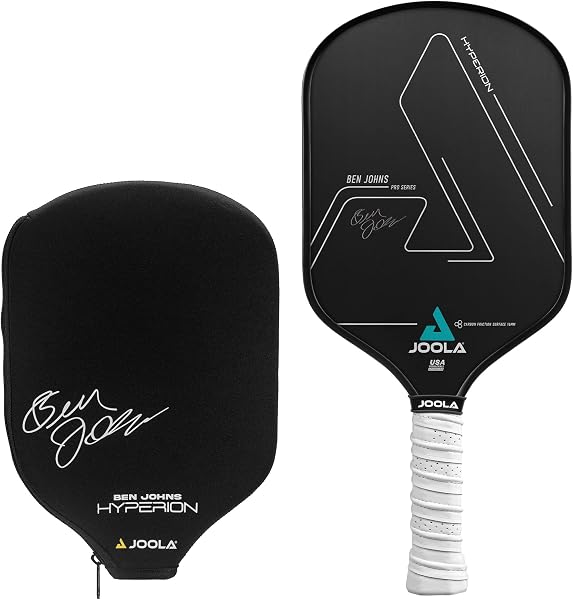
JOOLA Ben Johns Hyperion CFS
★ 4.4 · 283 Amazon reviews- Brand
- JOOLA
- Signature
- Ben Johns
- Face
- Carbon friction surface (CFS)
- Shape
- Hyperion (balanced)
- Feel
- Controlled, spinny
- Reviews
- 283+ on Amazon
- Play style
- Control + spin
- Price tier
- $$ (~$160)
Before the Perseus line took over, the Hyperion was the paddle most associated with Ben Johns – the most successful player in the sport’s history. The Hyperion CFS keeps that legacy alive at a much friendlier price.
CFS stands for carbon friction surface, and that is the key to its appeal. The textured face grabs the ball well, so spin on serves, rolls and dinks is excellent for the price. The Hyperion shape is more balanced than the very long Perseus, giving a generous sweet spot and a forgiving, stable feel.
It is a control-first paddle. Dinks and drops are comfortable, blocks are steady, and you can play a patient soft game with confidence. Power is moderate – enough to drive, but not the explosive pop of the newer foam or KineticFrame paddles.
Its 4.4-star rating from 283+ reviews shows that a lot of players have been happy with it for a long time. For many people it is the paddle that first made them feel like they were playing with ‘pro’ equipment.
If you want a proven pro paddle without spending $300, this is the one we would recommend first.
What we like
- Ben Johns signature model with real pedigree
- Excellent spin from the CFS face
- Forgiving, balanced shape
- Strong 4.4★ rating across 283+ reviews
Keep in mind
- Older generation than the Pro V
- Less power than newer foam paddles
JOOLA Pro IV (Perseus)
★ 4.2 · 100 Amazon reviews- Brand
- JOOLA
- Generation
- Perseus Pro IV
- Face
- Raw carbon fiber
- Shape
- Elongated Perseus
- Feel
- All-court
- Reviews
- 100+ on Amazon
- Play style
- All-court
- Price tier
- $$ (~$150)
The JOOLA Pro IV was the flagship before the Pro V arrived. Now that its successor is out, the Pro IV has dropped into the ~$150 tier, which makes it one of the most interesting value buys in premium pickleball.
You still get a raw carbon fiber face and the elongated Perseus shape that made this family famous. Spin is very good, the reach is excellent, and the paddle has an all-court personality that suits most intermediate players.
What you give up is the newest KineticFrame construction of the Pro V. The Pro V feels a little more refined and powerful, but for most recreational players the difference is far smaller than the price gap.
Its 4.2-star rating across 100+ reviews is slightly lower than the others on this list, and the elongated shape is less forgiving than a wide body. Still, for a former flagship at this price, the value is hard to argue with.
If you want the Perseus experience and do not need the very latest tech, the Pro IV is a smart, budget-conscious way into premium.
What we like
- Former flagship at a much lower price
- Raw carbon face with strong spin
- Elongated reach of the Perseus shape
- Great value for intermediate players
Keep in mind
- Replaced by the newer Pro V
- Slightly lower rating (4.2★)
Buying Guide: How to Choose a Premium Pickleball Paddle
Spending $200–$300 on a paddle only makes sense if it suits your game. Here are the factors that matter most.
1. Power vs. control
Every paddle sits somewhere between power and control. Power paddles (JOOLA Pro V, CRBN Barrage, Selkirk ERA Power, Paddletek TKO-CX) make it easier to hit hard drives and put-aways. Control paddles (CRBN Genesis, Selkirk LUXX Control, JOOLA Hyperion CFS) make it easier to dink, drop and reset. If you mostly play doubles at the kitchen line, lean towards control. If you play singles or love to attack, lean towards power.
2. Core type: foam vs. honeycomb
Most paddles use a polypropylene honeycomb core. It is light and responsive, but over time it can suffer from “core crush” and start to feel dead or inconsistent. Newer foam-core paddles, like CRBN’s TruFoam line, are designed to avoid this and need no break-in period. If you play often and hate replacing paddles, foam is worth considering.
3. Core thickness
Thicker cores (around 16mm) feel softer, more stable and more forgiving. Thinner cores (around 13–14mm) feel crisper and more powerful but demand cleaner contact. The JOOLA Pro V comes in both 14mm and 16mm versions, while the Paddletek TKO-CX uses a thin 14.3mm core.
4. Face material
Raw or textured carbon fiber is the standard on premium paddles because it grips the ball and produces heavy spin. Fiberglass faces add power but usually less control. Almost every paddle on this list uses carbon fiber in some form, which is a big part of why they cost more.
5. Shape
Elongated paddles (like the Perseus shape) give extra reach and a faster swing, and their long handles suit two-handed backhands. Wide-body or standard shapes have a bigger sweet spot and are more forgiving. Hybrid shapes, like the JOOLA 3S, try to combine both.
6. Weight and grip
Most premium paddles weigh between 7.8 and 8.4 ounces. Heavier paddles add stability and plow-through; lighter paddles feel quicker. Grip length matters too – longer handles (5.5″ and up) help two-handed players, while shorter handles leave more face area.
7. USAP approval
If you play sanctioned tournaments, make sure your paddle is approved by USA Pickleball. Major brands such as JOOLA, Selkirk, CRBN, Paddletek and Franklin generally submit their paddles for approval, but always check the specific model before a tournament.
Are Expensive Pickleball Paddles Worth It?
It depends on how often you play and how serious you are about improving.
For beginners, a $300 paddle will not fix technique. Beginners benefit far more from lessons and court time than from premium equipment. A good $50–$100 paddle is perfectly fine for the first few months.
For intermediate and advanced players, the difference is real. Premium carbon faces generate noticeably more spin. Better frames add power without losing touch. Foam cores and higher-quality construction last longer and stay consistent. If you play three or more times a week, the cost per game of a premium paddle is surprisingly low.
A good middle ground is the JOOLA Hyperion CFS or JOOLA Pro IV, which give you a proven pro paddle in the $150–$160 tier. If you want the very best and are happy to pay for it, the JOOLA Pro V is our top pick.
How to make an expensive paddle last longer
- Use a paddle cover and keep it out of hot cars – heat can damage cores and edge guards.
- Clean the carbon face gently with a damp microfiber cloth or a dedicated paddle eraser to restore grip.
- Replace the overgrip regularly so the handle stays comfortable and secure.
- Avoid hitting the court or the fence with the edge – most cracks start there.
Frequently Asked Questions
What is the most expensive pickleball paddle?
The most expensive playable paddle is the JOOLA Ben Johns Gold Perseus, a limited edition of 100 that resells for around $8,000. On Amazon, the most expensive mainstream paddle is the JOOLA Pro V, in the ~$300 tier.
What is the most expensive pickleball paddle in the world?
Luxury sets top the list: a Louis Vuitton pickleball set was reported at around $100,000, and a Versace set at around $9,000. These are designer items rather than performance equipment.
How much does a high-end pickleball paddle cost?
Premium performance paddles usually cost between $150 and $300. Flagship models from JOOLA, Selkirk and CRBN sit at the top of that range.
Is the most expensive pickleball paddle the best?
Not always. Price usually reflects newer technology and better durability, but the best paddle is the one that matches your style. A control player may prefer the Selkirk LUXX Control or CRBN Genesis over the more powerful JOOLA Pro V.
What is the most expensive pickleball paddle brand?
Among mainstream brands on Amazon, JOOLA and Selkirk sit at the top of the price range, followed by CRBN, Paddletek and Franklin.
Which expensive pickleball paddle lasts the longest?
Foam-core paddles like the CRBN TruFoam Genesis are designed to avoid core crush, so they tend to stay consistent longer than many honeycomb paddles.
Should a beginner buy an expensive pickleball paddle?
Usually not. Beginners improve faster with lessons and practice. Consider a premium paddle once you play regularly and know whether you prefer power or control.
What paddle do pro pickleball players use?
Many top pros use JOOLA Perseus-family paddles, while others play Selkirk, CRBN, Paddletek and other premium brands. Pros often have custom set-ups, but the retail flagship models are very close.