
Are Expensive Pickleball Paddles Worth It? An Honest Answer
A $300 paddle won’t turn a beginner into a 4.5 player. But for the right player, a premium paddle makes a real difference in every game. Here’s how to know which camp you’re in.
Quick answer
Yes, if you play at least two or three times a week and already have solid basic technique. Expensive paddles ($150–$300) give you noticeably more spin, better consistency, a more forgiving sweet spot and a longer lifespan. No, if you are a beginner: lessons and court time will improve your game far more than a $250 paddle. Most regular players get the best value from the $150–$230 range.
The short version
Paddles do matter, but they matter most once your technique is good enough to take advantage of them. A premium paddle amplifies what you already do well: it adds spin to a good roll, pace to a good drive and control to a good dink. It cannot fix poor footwork, bad positioning or rushed swings. That is why the same $300 paddle can feel transformative to a 3.5 player and almost pointless to someone in their first month.
Does the pickleball paddle really matter?
Yes, but less than marketing suggests. Your paddle affects five things:
- Spin: how well the face grips the ball
- Power: how much pace you get from a given swing
- Control: how predictable the ball is off the face, especially on soft shots
- Forgiveness: how stable the paddle is on off-centre hits
- Consistency over time: whether it plays the same in month six as in week one
For a beginner, mistakes come mainly from timing, footwork and decision-making, so the paddle’s influence is small. For an intermediate or advanced player, those five factors start to decide close points. A paddle that adds a little more spin to your third-shot drop or a little more stability to your blocks can be the difference in a tight game.
Does an expensive pickleball paddle make a difference?
Here is what you actually gain when you move from a budget paddle to a premium one.
More spin
Premium paddles use raw or textured carbon fiber faces that grip the ball. Topspin drives dip into the court, roll volleys curve down at your opponents’ feet and slice serves skid. Budget fiberglass faces are smoother and lose what texture they have quickly. Read more in carbon fiber vs fiberglass.
Better consistency
Cheap honeycomb cores can break down and develop dead spots. Premium cores are tuned more carefully, and foam cores are designed to avoid core crush altogether. A consistent paddle lets you trust your shots, which matters more as rallies get faster.
Power without losing touch
Older power paddles felt like trampolines: great on drives, terrible on dinks. Modern premium designs balance the two. JOOLA’s KineticFrame on the Pro V, for example, is designed to add pop when you swing hard while staying calm on soft shots.
A bigger, more stable sweet spot
Thermoformed construction and better weight distribution make off-centre hits more forgiving. Fewer mishits fly into the net or out of bounds.
Longer lifespan
Premium paddles usually last longer before losing performance, and foam-core paddles are designed to stay consistent even longer. See How Long Does a Pickleball Paddle Last?
When an expensive paddle is worth it
- You play two or more times a week
- You are rated around 3.0–3.5 or above and improving
- You are working on spin shots like rolls, topspin drives and cut serves
- You play leagues, ladders or tournaments
- You are tired of replacing paddles that go dead after a few months
- You come from tennis, squash or another racquet sport and already have good hand skills
When an expensive paddle is not worth it
- You are in your first few months of playing
- You play only occasionally or socially
- You are still learning the basics of the soft game
- You are buying for kids, guests or a family set
- Your budget would be better spent on lessons or clinics
Should a beginner buy an expensive pickleball paddle?
In most cases, no. In your first three to six months you are learning the fundamentals: where to stand, how to return serve deep, the third-shot drop and kitchen patience. A comfortable $50–$100 paddle is more than enough, and you will learn faster by spending the difference on lessons.
There are two exceptions. If you come from a racquet sport and already have strong hand-eye coordination, you will progress quickly and may benefit from a better paddle sooner. And if you already know you will play several times a week, buying a mid-tier premium paddle once can be cheaper than upgrading twice.
Even then, a $150–$160 paddle such as the JOOLA Hyperion CFS or JOOLA Pro IV is a smarter first premium purchase than a $300 flagship. Both are forgiving, spin-friendly and proven.
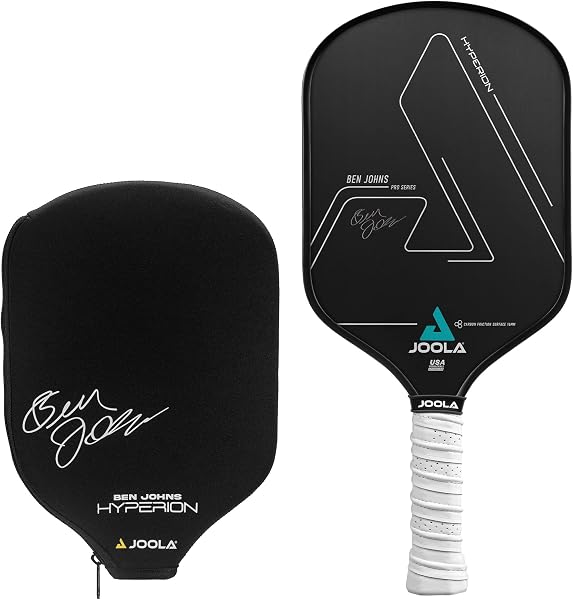
JOOLA Ben Johns Hyperion CFS
★ 4.4 · 283 Amazon reviewsForgiving, balanced shape and a carbon friction surface for spin.

JOOLA Pro IV (Perseus)
★ 4.2 · 100 Amazon reviewsFormer JOOLA flagship now around $150.
Who should buy a premium paddle? A quick guide
| Player type | Worth it? | Suggested budget | Example paddle |
|---|---|---|---|
| Brand-new player | Not yet | $40–$80 | Any comfortable composite paddle |
| Casual, once a week | Maybe | $80–$150 | JOOLA Pro IV |
| Regular, 2–3x a week (3.0–3.5) | Yes | $150–$230 | CRBN Genesis or Selkirk SLK ERA Power |
| Competitive (3.5–4.5+) | Definitely | $200–$300 | JOOLA Pro V |
Is a $300 pickleball paddle worth it?
A $300 flagship like the JOOLA Pro V is worth it for advanced players who play often and want the newest technology. It is the most complete all-court paddle on Amazon, with power, spin and touch in one package. Read our JOOLA Pro V review for the details.
For most other players, the jump from a $200 paddle to a $300 paddle is smaller than the jump from $80 to $200. You get diminishing returns at the top, which is why we usually recommend the $150–$230 range for regular players.

JOOLA Pro V (Perseus)
★ 4.4 · 162 Amazon reviewsKineticFrame construction, raw carbon face, elongated Perseus shape.
The cost-per-game argument
Think about how often you will use the paddle. A $230 paddle used three times a week for a year costs about $1.50 per session. A $70 paddle that loses its pop after four months of the same schedule costs about $1.35 per session and then needs replacing, often more than once a year. For frequent players, premium paddles can cost almost the same per game while playing much better.
The durability argument
One of the most overlooked reasons to buy premium is consistency over time. A paddle that changes as its core breaks down forces you to keep adjusting. Foam-core paddles such as the CRBN TruFoam Genesis are designed to avoid core crush and need no break-in, so they play the same for longer. That consistency is worth a lot if you play competitively. Read our CRBN TruFoam Genesis review or our guide to foam core vs honeycomb.

CRBN TruFoam Genesis
★ 4.5 · 135 Amazon reviewsAll-foam core designed to stay consistent without break-in.
Common myths about expensive paddles
“An expensive paddle will make me a much better player”
It will help with spin, consistency and forgiveness, but technique matters far more. Think of a premium paddle as an amplifier rather than a fix.
“The most expensive paddle is always the best”
Not true. The best paddle is the one that matches your style. A control player may prefer the Selkirk LUXX Control or CRBN Genesis to a more powerful, more expensive flagship. See our picks by style in best paddles for advanced players.
“Pros use $300 paddles, so I need one too”
Pros use paddles that suit their game, often with custom set-ups. You will get more benefit from choosing the right shape, thickness and weight than from matching a pro’s exact model.
“Cheap paddles are all the same”
Budget paddles vary a lot. A well-made $80 paddle can be far better than a poorly made $150 one. Reviews and brand reputation matter at every price.
How to get the most value from a premium paddle
- Buy the previous flagship when a new one launches. Compare JOOLA Pro V vs Pro IV.
- Match the paddle to your style: power, control or all-court.
- Choose the right thickness: 14mm and under for pop; 16mm for control.
- Protect it with a paddle cover and keep it out of hot cars.
- Check reviews: we look for 4.2 stars or higher with a meaningful number of reviews.
What about the most expensive paddles in the world?
Collector and designer paddles, such as the Gold Perseus or the Louis Vuitton set, are not worth it for performance. You are paying for rarity and brand, not spin. They make sense only as collector items or gifts.
A smart upgrade path by skill level
Rather than jumping straight to a $300 paddle, many players get the best results by upgrading in steps that match their progress.
Stage 1: Learning (first 3–6 months)
Use a comfortable composite paddle in the $50–$100 range. Focus on lessons, drills and learning the soft game. Pay attention to whether you naturally prefer hitting hard or playing patiently, because that will guide your next paddle.
Stage 2: Regular play (around 3.0–3.5)
This is the right time for your first premium paddle. Choose a forgiving carbon paddle in the $150–$200 range, such as the JOOLA Hyperion CFS, the JOOLA Pro IV or the Selkirk SLK ERA Power. You will immediately notice more spin and a more stable sweet spot.
Stage 3: Competitive play (3.5–4.0+)
Now your style is clear, and a paddle tuned to it pays off. Control players do well with the CRBN TruFoam Genesis or Selkirk LUXX Control; power players with the CRBN TruFoam Barrage or Paddletek Bantam TKO-CX; all-court players with the JOOLA Pro V.
Stage 4: Tournament level
At this stage, small details matter: thickness, swing weight, handle length and shape. Many tournament players keep two identical paddles so they always have a consistent backup. Spending at the top of the market makes the most sense here.
Questions to ask before you buy
Before spending $200 or more, ask yourself three simple questions. How many times a week do I really play? Do I know whether I prefer power or control? And would a lesson help me more right now than new equipment? If you play often, know your style and your basics are solid, a premium paddle is a smart buy.
Our verdict
If you play regularly, an expensive pickleball paddle is worth it. It is one of the few upgrades you will feel in every game, and premium paddles often last long enough to justify their price. If you are just starting, wait, take some lessons, and upgrade once you know your style.
When you are ready, compare your options in our ranked list of the 10 most expensive pickleball paddles worth buying, check what each price tier gets you, or see the real differences in cheap vs expensive paddles.
Key takeaways
- Premium paddles are worth it for players who play two or more times a week.
- Beginners benefit more from lessons than from a $300 paddle.
- Most regular players get the best value in the $150–$230 range.
- Former flagships deliver premium performance for much less.
Frequently Asked Questions
Is a $300 pickleball paddle worth it?
For advanced players who play often, yes. Most regular players get nearly the same benefits from a $150–$230 paddle.
Does an expensive paddle improve your game?
It improves spin, consistency, forgiveness and power for players with solid technique. It will not fix basic technique problems.
Should a beginner buy an expensive pickleball paddle?
Usually not. Spend $40–$80 at first, then upgrade once you play regularly and know your style.
Does the pickleball paddle really matter?
Yes, especially for intermediate and advanced players. It affects spin, power, control, forgiveness and consistency.
What is the best value premium paddle?
The JOOLA Pro IV and Hyperion CFS offer flagship-level feel for around $150–$160, while the CRBN Genesis offers the best long-term durability.